 Alankomaat
 Albania
 Amerikan yhdysvallat
 Argentiina
 Australia
 Belgia
 Bosnia ja Hertsegovina
 Brasilia
 Bulgaria
 Chile
Chile
 Espanja
 Etelä-Afrikka
 Filippiinit
 Irlanti
 Iso-Britannia
 Italia
 Itävalta
 Kanada
 Kolumbia
 Kreikka
 Kroatia
 Latvia
 Liettua
 Luxemburg
 Meksiko
 Moldova
 Montenegro
 Norja
Norja
 Pohjois-Makedonia
 Portugali
 Puola
Puola
 Ranska
 Romania
 Ruotsi
 Saksa
Saksa
 Serbia
 Slovakia
 Slovenia
 Suomi
Suomi
 Sveitsi
 Tanska
 Turkki
 Tšekin tasavalta
 Ukraina
 Unkari
 Uusi-Seelanti
 Viro
Viro







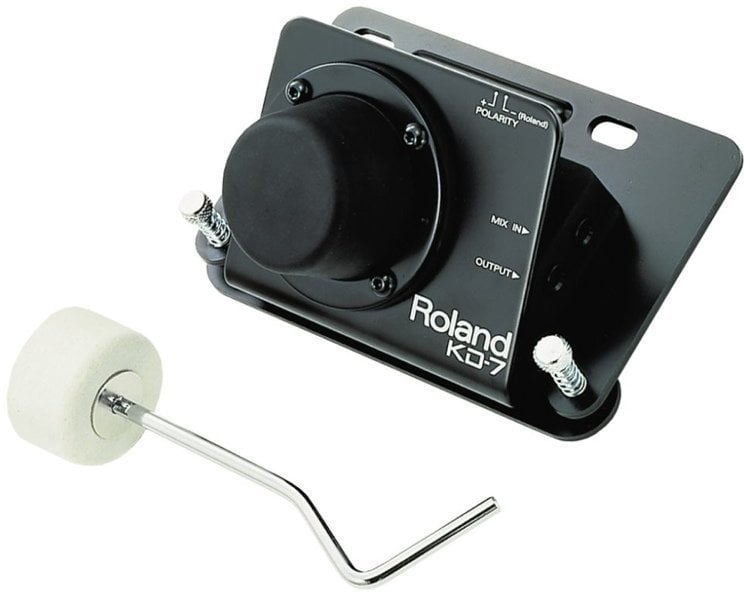
Roland KD-7 Sähkörummun laitteisto
The Roland KD-7 is a dynamics-sensitive kick trigger unit designed for electronic drum setups, hybrid rigs, and percussion modules. It accepts any standard kick drum pedal and pairs with the included KDB7 reverse beater for natural playing feel.
- Velocity-sensitive technology captures every nuance of your footwork, from ghost strokes to full-power accents.
- Mix input lets you chain a second unit for double-bass setups without extra splitter cables.
- Compact 172 x 112 x 100 mm footprint and 1.4 kg weight keep the unit stable on stage or in the studio.
- Compatible with Roland V-Drums modules, the HPD-15 hand percussion unit, and third-party trigger interfaces.
Velocity-Sensitive Bass Drum Triggering for Electronic Percussion
The Roland KD-7 is a dynamics-sensitive kick drum trigger that brings acoustic-style response to any electronic percussion rig. It works with a standard kick drum pedal and ships with a KDB7 reverse beater plus cable. The unit drops into a V-Drums setup, a hybrid kit, or a module like the HPD-15 or RMP-1. For drummers wanting reliable bass drum triggering without a full kick tower, this compact trigger is the answer.
What Sets the KD-7 Apart
The KDB7 reverse beater geometry keeps the pedal action natural and prevents the unit from creeping during heavy playing. A rear-panel mix input lets you daisy-chain a second KD-7 for double-bass patterns without an external splitter. A polarity switch and output level toggle round out compatibility with Roland modules and third-party trigger interfaces.
Velocity Sensitivity and Dynamic Response
The trigger reads the velocity of every stroke and sends a continuous range of dynamics to the connected module. Ghost strokes, accents, and heel-toe patterns translate into the same expressive range as an acoustic kick.
- Velocity sensitivity provides a dynamic, continuous range that captures ghost strokes through full-power accents.
- Polarity Switch: Selectable — matches signal phase to different module inputs
- Output Level Toggle: Adjustable — calibrates trigger output to module sensitivity
Compact Footprint and Road-Ready Build
At 172 mm wide, 112 mm deep, and 100 mm tall, the unit takes up less floor space than a typical kick tower. The 1.4 kg weight (including beater) keeps the unit planted during heavy playing, and bottom-mounted velcro grips carpeted stages.
- Dimensions: 172 x 112 x 100 mm — narrow enough to sit beside an acoustic kick pedal
- Weight: 1.4 kg (including beater) — heavy enough to resist creeping on stage
Mix Input, Cable, and Module Compatibility
The device ships with a cable long enough to reach a module on a stand or rack, and the rear-panel mix input accepts the output of a second unit for double-bass chains. Roland positions this trigger as the ideal partner for the HPD-15 and RMP-1, and it works with V-Drums modules and most third-party trigger interfaces.
- Mix Input allows you to daisy-chain a second trigger for double-bass setups directly via the rear panel.
- Included Cable: Approx. 3.35 m (11 ft) — reaches modules on stands or racks
Who Should Choose This Model
It is the right choice for drummers building a hybrid kit who need a compact, reliable kick trigger that accepts any standard pedal. The unit suits studio players layering electronic samples under an acoustic kick, gigging drummers who want a portable backup, and electronic percussionists running the HPD-15 or RMP-1. Players with a Roland V-Drums module will find this a drop-in upgrade.
The V-Drums Legacy
The manufacturer introduced this trigger as part of its long-running V-Drums ecosystem, the family that pioneered electronic percussion for studio and stage use. The unit shares its design DNA with the PD-7, PD-9, and FD-7 controllers, all in the same owner's manual. For drummers who already rely on Roland modules, this instrument continues the company's focus on responsive triggering.

Yhteensopiva
Materiaali
Muovi, Teräs
Pakkauksen sisältö
Valmistettu
Japani
Asiakirjat
Turvallisuusohjeet
Katso tämän tuotteen turvallisuusohjeet käyttöoppaasta.